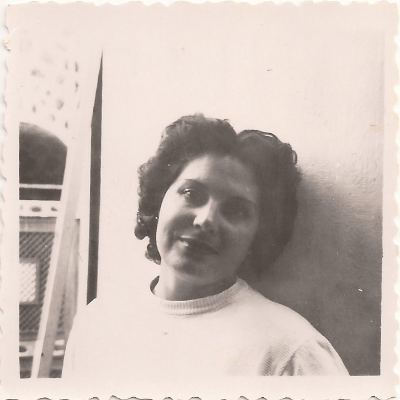
Biography of Pino Ojeda
Pino Ojeda Quevedo (El Palmar de Teror 1926 – Las Palmas de Gran Canaria, 2002) is one of the writers and plastic artists of international projection who most strongly demand to be rescued from the cruel and inexplicable oblivion to which she has been subjected within the borders. of his own country. With this article, we take a brief tour of his brilliant career, with the aim of contributing, as far as possible, to the dissemination of his work and figure.
The beginnings of Pino
Pino Ojeda began writing poetry after the tragic death of her husband in 1929, which occurred on the front lines of Extremadura, during the Spanish Civil War. This fact gives rise to an intimate literature that addresses the themes of loneliness, the inexorable passage of time, death and hope. His literary career began in 1940, in the Tenerife magazine Message, where he published some of his poems. In addition, this magazine published his first book, Fog of Sleep, in 1947. However, it was in 1953, the year in which he won the First Accésit of the Adonais Prize with his collection of poems Como el fruit en el arbol (published in 1954), when She began to be recognized nationally within the writers’ guild, performing readings and recitals in cities such as Barcelona and Madrid, where she established ties of friendship with the plethora of post-war Spanish authors: Gerardo Diego, Juan Ramón Jiménez, Vicente Aleixandre and Carmen Conde. , among others.
In 1956, Pino Ojeda received the Tomás Morales Prize for The Stone on the Hill, a poem divided into donde ranches published in 1964. In 1987, El alba en la corazón appeared, and in 1993, El salmo del rocío, a book of poems that won the First World Prize for Mystical Poetry, organized by the Fernando Rielo Foundation in 1991. Tree of Space (2007) is published posthumously, illustrated by Plácido Fleitas and Juan Ismael.
The rest of his literary work (stories, plays and an important novel, titled With Paradise in the Background, finalist for the Nadal Prize in 1954) still remains, and inexplicably unpublished. Fortunately, the writer’s family preserves the unpublished works of these works in Las Palmas de Gran Canaria, with the hope that one day they can see the light, and above all, be studied and valued as they deserve.
Editor
Collaborator in national and foreign magazines, such as Poesía Española (Madrid), Estafeta Literaria (Madrid), Revistart (Barcelona), Caracola (Málaga), A/-Motamid (Vetuán) or Profil Littéraire de la France (Belgium, directed by Henri de Lescoét), to name just a few, Pino Ojeda had the courage to found and direct, from Gran Canaria, his own magazine. This is Alisio. Poetry Sheets (1952-1955), in which very prominent authors from the Generation of ’27, the Generation of ’50, or somewhere between the two, would publish.
Financed with his own savings, Alisio… is a commitment by Pino Ojeda not only to establish solid creative ties between the islands and the peninsula, thus breaking the fictitious limits of the horizon; but also, for combining plastic art and literature, since in these poetic spreads the illustrations are very important, with which the poet who stars in each installment is portrayed. The edition, characterized by an elegant sobriety, was enriched by also adding the autograph signature of each author.
Gerardo Diego, Pedro Salinas, Pedro Perdomo Acedo, Ventura Doreste, Manuel Pinillos, Carmen Conde, Jacinto López Gorgé, Pino Ojeda, Rafael Montesinos, Vázquez Díaz, Chona Madera, Leopoldo de Luis, Gabriel Celaya, González Castrillo, Joaquín de Entrambasaguas, Juan Ismael, Manolo Millares, Vicente Aleixandre, José Luis Cano, Enrique Azcoaga, Concha Zardoya, Pedro Lezcano, Carlos Rodríguez Spiteri, Angelina Gatell, Dictinio del Castillo Elejabeitia, Emeterio Gutiérrez Albelo, María Beneyto, Ramón González- Alegre Balgoma, Mario Ángel Marrodán, Miguel Fernández, Juan Ramón Jiménez and the Frenchman Louis Emié make up the list of poets and illustrators who made up Alisio’s career. Sheets of poetry, weaving with his works, for two and a half years, a line of social poetry and angry denunciation of the embers of war. Because, logically, the fact of founding the magazine in 1952 was decisive in the choice of the thematic lines most present in the spreads: the political, social and spiritual content is constant, like a flag that demands freedom and justice, from the first to the last collaborations.
Painter
On the pictorial level, Pino Ojeda managed to exhibit his work in countries such as the United States, Switzerland, Sweden, Germany and Italy, holding individual and collective exhibitions, traveling and permanent, in museums and galleries, in addition to being praised by renowned art critics. who consider her one of the precursors of abstract art in the Canary Islands. Let’s imagine what it meant, for a Canarian woman in the fifties, a widow and mother of one child, to carry out all these cultural activities, making international trips alone carrying canvases and materials, in addition to defying the constrained norms of the Franco dictatorship.
Among other activities and anniversaries of his career in the plastic arts, it is worth highlighting: in 1947 he entered the Luján Pérez School, although several years had already passed since he began to paint. In 1955 he exhibited his pictorial work for the first time in the 3rd. Hispano-American Art Biennial in Barcelona. Two years later, the first anthological exhibition of his pictorial work was held at the Institute of Hispanic Studies of Puerto de la Cruz, in Tenerife. In the 1950s, the painter founded the Las Canteras Beach Art Gallery, dedicated exclusively to the exhibition and sale of works by numerous visual artists; and in 1959, he exhibited his work at the National Library of Paris.
In 1960, he entered the Municipal Academies of Las Palmas, with the aim of perfecting his drawing. In 1961, she exhibited with the Espacio Group, being one of its founders. The following year, he received First Prize in the National Plastic Arts Contest for his work Ciudad amurallada. In 1964 he exhibited in Mallorca, at the Grifé & Escoda Gallery, in whose catalogue, the writer Camilo José Cela presents the work of Pino Ojeda. This same year, he also exhibited at the Sala Club Pueblo, in Madrid. In 1965, the exhibition of Pino Ojeda’s work at the Ateneo de Barcelona and the Syra Gallery stands out. The following year, the Gran Canaria painter received the First Prize of Pintum at the 12th Regional Exhibition of Fine Arts, for her work Serenidad, at the Literary Cabinet of Las Palmas de Gran Canaria. In 1972, Pino Ojeda exhibited his works at the St. Paul Gallery in Stockholm, Sweden. The following year, he exhibited at the Giorgi Gallery in Florence, Italy. Between 1973 and 1975, he studied at the Higher School of Fine Arts of Las Palmas de Gran Canaria, and began his ceramics studies with the teacher Eduardo Andaluz.
In 1975, his exhibition at the Margherita Gallery of Porto Potenza, in Italy, stands out. A year later, he exhibited at the Luciano Berti Gallery, in Bern, Switzerland; and in 1977, 10 years ago at the John W. Allen Gallery in Florida, United States. The following year, he exhibited at the Hans Kramer Gallery in Freiburg, Germany. In 1980, its 2nd Anthological Exhibition was held, at the inauguration of the Malteses Gallery in Las Palmas de Gran Canaria. Between 1980 and 1983, his temporary disability only allowed him to work on small-format works, and on his psychic drawings and collages. In the year 2000, the 1st Exhibition of “Pioneers of Canarian Art: Lola Massieu, Jane Millares, Pino Ojeda” was held at the Casino of Las Palmas de Gran Canaria. In 2001, the 2nd Exhibition “Pioneers of Canarian Art” was held at the Municipal Museum of Arucas.
Pino Ojeda and criticism
The case of Pino Ojeda represents a paradox: on the one hand, he enjoys great prestige at a national and international level among literary and art critics: very favorable articles and reviews have been written about his works by the poet, critic and member of the Royal Swedish Academy Artur Lundkvist, the art critic José Corredor-Matheos, the writer Carmen Conde or the literary critic and Canary Islands Literature Prize winner María Rosa Alonso, to name just a few. It also has a detailed biography, carried out by the historian Juan Francisco Santana Rodríguez, titled Pino Ojeda: Painter and poet (2008), which is included in various anthologies and has been translated into Swedish, Italian, German, English and French.
However, Pino Ojeda continues to be unknown to most readers of the Canary Islands. His published works—very few, compared to the numerous unpublished ones that remain—despite having won awards of enormous notoriety, are not found in the publishing circuit: they can only be obtained in some libraries and second-hand bookstores. And what is more serious, is a diffuse and poorly attended figure within the academic field – plastic and philological – of the Islands, in specialized and long-term works. For this reason, a process of awareness and dissemination of her figure is necessary, now more than ever, in the land where she was born.